
East Feliciana Supervision Types
Parole and probation can both place an East Feliciana Parish person in the community, but they begin through different legal decisions. Parole permits a person to serve the rest of a prison sentence under Louisiana DPS&C supervision. Probation is imposed by a court, often with a suspended jail or prison term. Neither status by itself proves the date or time the person physically left East Feliciana Parish Prison.
The Louisiana Committee on Parole decides parole matters. The DPS&C Division of Probation and Parole supervises people after release. A 20th Judicial District court order controls local probation. The Feliciana District office handles the local supervision work, subject to case assignment and disclosure limits.
| Feature | Parole | Probation |
|---|---|---|
| Who authorizes it | Louisiana Committee on Parole when the law allows | The sentencing court |
| What it means | The prison sentence continues under community supervision | The court imposes supervised conditions, often with a suspended term |
| Key record | Parole decision, release event, and supervision record | Judgment, minutes, and probation record |
| Local office | Feliciana Probation and Parole when assigned there | Feliciana Probation and Parole when assigned there |
- Parole
- Release from confinement while a sentence continues under supervision.
- Probation
- A court-ordered period of supervision in the community.
- Discharge
- The end of the relevant supervision authority.
- Absconder
- An official supervision status or allegation, not merely a missed appointment.
Verify East Feliciana Supervision
Start with the source that created the status. A parole docket can show the Committee's decision, yet a grant may still depend on conditions, a plan, a detainer, an effective date, and release processing. Court minutes can show probation, but they do not supply the jail's door-out time. LAVNS may show community supervision after physical release. Read these records together.
- Search the Louisiana VINELink person search using the full name and an available ID.
- For parole, check the Committee on Parole dockets and results. Match the name, DOC number, institution, hearing type, and date.
- For probation, obtain the 20th Judicial District judgment or minute entry through the East Feliciana Clerk.
- Contact Feliciana Probation and Parole with the name, date of birth or DOC number, and a purpose-neutral request to confirm jurisdiction or available public status.
- Confirm physical release separately through the facility or custody-event record. A decision and an actual departure are different facts.
When there are similar names, stop until the identifier matches. If a public locator returns nothing, do not label the person discharged. Louisiana does not promise permanent public visibility after supervision ends. Ask the appropriate records custodian for the durable record.
East Feliciana Supervision Office
Feliciana Probation and Parole is physically located in Clinton. Its official district page says the office covers East and West Feliciana Parishes plus specified East Baton Rouge Parish ZIP codes. That wider service area matters: the reported district caseload is not an East Feliciana-only count. The office reports roughly 1,200 supervised cases across its jurisdiction and names Corey Felder as district manager as of the research date.
Feliciana Probation and Parole
9508 Plank Road, Suite B
Clinton, LA 70722
Mail: P.O. Box 7980
(225) 683-5012
Monday through Friday, 8:00 a.m. to 4:30 p.m.
Use the office to verify which district has a case and what public active-supervision facts can be released. Person-specific addresses, reporting schedules, alleged conditions, and violation details may be restricted. The office is not the source for the East Feliciana jail's exact release timestamp. For that fact, obtain the prison custody-event record.
The official Feliciana District page publishes the office's coverage, contact, hours, and work.
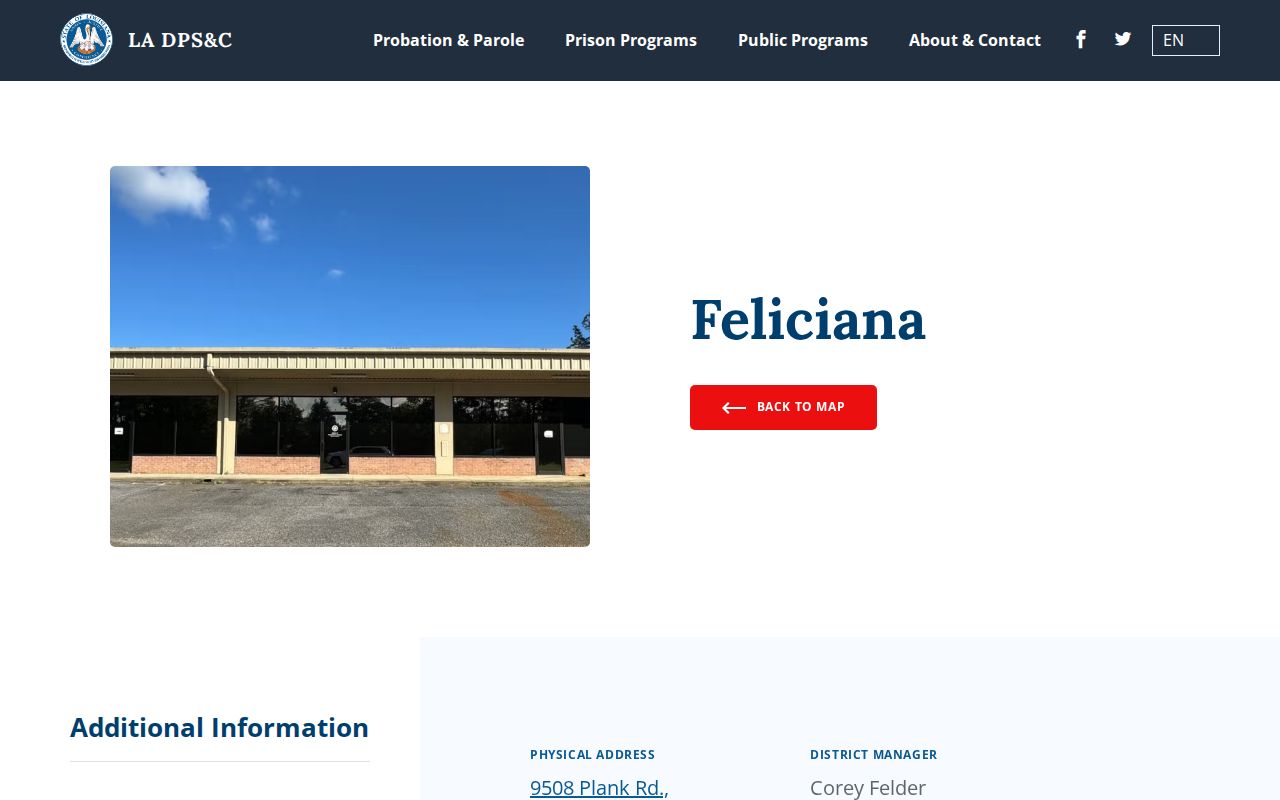
The office page is the right source for current district information, while a matched agency or court record establishes the person's status.
District officers also attend or monitor 20th Judicial District proceedings each week and monitor two transitional work programs. Those duties make the Clinton office a practical bridge between state supervision, local court action, and work-program departures. They do not make its broad caseload a parish-only statistic. Confirm the assigned district for the named person before relying on the office as the current supervising authority.
East Feliciana Supervision Changes
Supervision conditions are set in the governing release certificate, parole decision, judgment, and agency rules. Common topics can include reporting, approved residence, travel, treatment, fees, and compliance with law, but a generic list must not be assigned to one person. Use the person's official document. Louisiana's published parole conditions direct reporting no later than 48 hours after release, while the local office can clarify jurisdiction and procedure.
An alleged violation does not automatically prove revocation. The agency, court, or board must take the relevant action. Revocation concerns the consequences of conduct after release and may return a person to custody. Rescission can undo a parole grant before release. A deferral postpones a decision. Those terms should be copied from the actual docket or order, not inferred from a missing VINELink result.
No East Feliciana sheriff absconder or warrant list was verified. An absconder is an official status or allegation, not a label for someone who missed one meeting. Verify a claimed warrant through the issuing authority and court. If LAVNS shows a supervision change, note the event date and agency, then seek direct confirmation.
Note: A parole decision, warrant claim, or locator change must be matched to the right identity before it is reported.
East Feliciana Supervision Discharge
Supervision ends through an official discharge or other controlling action. Physical release from prison is earlier than full discharge when the person remains on parole or good-time parole supervision. Louisiana R.S. 15:571.5 treats a DOC prisoner released by diminution as if on parole for the rest of the original full term. The person receives a certificate of conditions and remains subject to supervision. Good-time release is therefore not the end of all DPS&C authority.
A durable discharge check should identify the supervising agency, case or DOC number, discharge date, and status wording. Court minutes may document completion or termination of probation. DPS&C records can document the end of parole or state supervision. A missing public locator result cannot carry that meaning by itself because official sources do not guarantee indefinite display of fully discharged people.
Keep supervision discharge separate from the jail release event. The East Feliciana Parish released inmates and records path explains how to request the actual custody-ending date, reason, authority, and destination. Together, those records show both when confinement ended and when later supervision ended.
East Feliciana TWP Reentry Supervision
East Feliciana Parish has a local custody feature that changes the verification path. The parish prison co-locates a DOC-approved Transitional Work Program. The sheriff says all TWP participants are Louisiana DPS&C offenders approved for the program. It also names Hi-SET, discipleship training, re-entry, and trustee programming at the facility. Participation does not mean the sentence has ended.
A person can leave the TWP for the community under supervision, return to more secure DOC custody, or move through another transfer. The parish current roster alone cannot distinguish those outcomes. Check LAVNS and DPS&C records, ask the TWP what kind of departure occurred, review any parole decision, and contact Feliciana Probation and Parole if community supervision is shown.
This path matters because the local office monitors two regional transitional work programs and assigns officers to 20th Judicial District proceedings each week. Its role links the state sentence, the work program, and local court activity. Still, each record answers only its own question. A program departure is not always community release, and community release is not always full discharge.
The work program's reentry role is navigational, not a promise about one participant. The sheriff names Hi-SET, discipleship training, re-entry, and trustee programming, but participation or completion must come from an official individual record. Release to supervision should be verified through the actual TWP departure, the state status, and the local district assignment. A return to secure custody requires the receiving facility instead.
Note: Ask whether a TWP departure was release, supervision, return to secure custody, or transfer before describing the outcome.
Read Louisiana Parole Results
The Board of Pardons and Committee on Parole publishes changing hearing-week dockets and results. Open the relevant week and match the name, DOC number, institution, and hearing type. A grant authorizes parole subject to the governing requirements. A denial rejects parole under that decision. Scheduling material may also show that a matter was continued, removed, or withdrawn. Revocation pages concern supervision after release.
Eligibility is not a single statewide fraction. Louisiana R.S. 15:574.22 generally changes parole eligibility for offenses committed on or after August 1, 2024, subject to statutory exceptions. Earlier cases can fall under detailed provisions in R.S. 15:574.4, with different offense categories, dates, prior histories, and exclusions. Use the complete statute and the agency record. A rough percentage cannot establish eligibility or a release date for one East Feliciana Parish person.
A grant is not a door-out timestamp. Conditions, plan approval, a detainer, rescission, the effective date, and facility processing may remain. Confirm the actual release through LAVNS, DPS&C, or the holding facility, then verify active supervision through the Feliciana office. If a detainer appears, identify the receiving authority rather than saying the person returned to the community.
The current parole docket page is more reliable than one hard-coded weekly PDF.
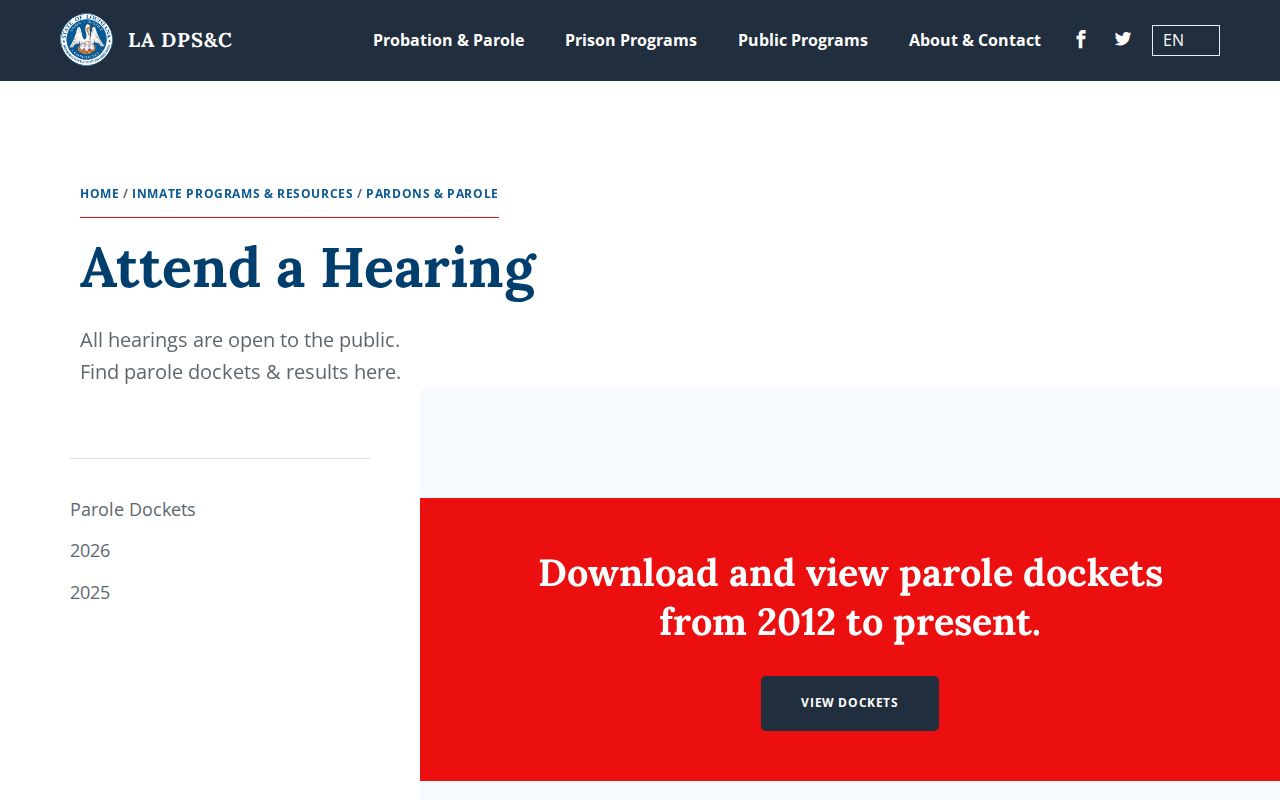
The landing page keeps current and past result links together, but the matched result still needs a later custody check.
Hearings are open to the public, conducted through Zoom, and streamed through the Board's published process. Observation of a hearing can explain the issue before the panel, but the signed or published result remains the record of the decision. Save the docket week and result together so a later custody check can be tied to the correct proceeding.